What is Relational Life Therapy and why is it effective in Couples Counseling?
Most relationship conflicts are not just about the present moment — they are shaped by the relational environments we grew up in.
As children, we learn how to relate to others based on the emotional dynamics around us. These early experiences form our sense of self and our boundaries, which then shape how we show up in adult relationships.
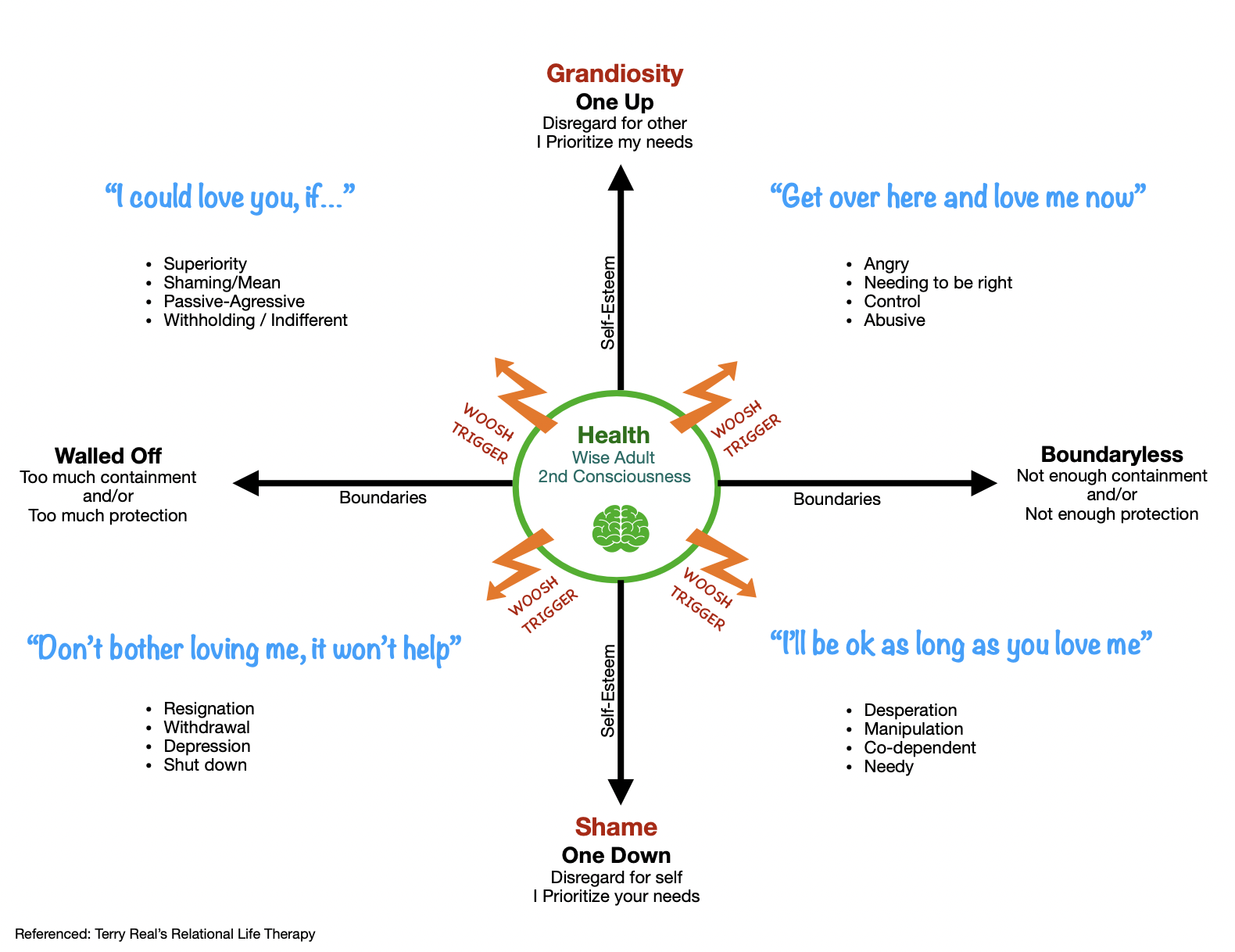
Relational Life Therapy uses a framework called the Relational Grid to help couples understand these patterns.
At the center of the grid is healthy relating — where both partners maintain a strong sense of self while staying connected to each other.
When we are triggered, many of us move away from that center in predictable ways.
Some people move into grandiosity (“one up”), where they become critical, controlling, or defensive in order to protect themselves.
Others move into shame (“one down”), where they withdraw, shut down, or prioritize their partner’s needs over their own.
Boundaries also play an important role. Some people learn to become walled off, building strong emotional barriers to avoid being hurt. Others become boundaryless, feeling responsible for their partner’s emotions and constantly trying to keep the relationship stable.
These patterns often began as intelligent survival strategies in childhood. For example, a child who had to take care of a struggling parent may grow up feeling responsible for everyone’s emotional well-being. Another child who felt overwhelmed or controlled may learn to protect themselves by distancing from others.
RLT helps couples recognize these patterns and understand how they are affecting the relationship today.
Rather than blaming one partner, the goal is to help both people move back toward the center of the grid, where each person can maintain their sense of self while staying emotionally connected.
In this work, partners learn how to:
recognize their relational triggers
take accountability without shame
communicate with honesty and respect
create healthier boundaries and deeper connection
Because these patterns are rooted in earlier relational experiences, RLT often includes trauma-informed work to help each partner’s nervous system feel safer in the relationship.
When couples begin to understand these dynamics, they often discover that the conflict between them is not random — it’s a pattern that can be changed.
The Relational Grid from Terrence Real
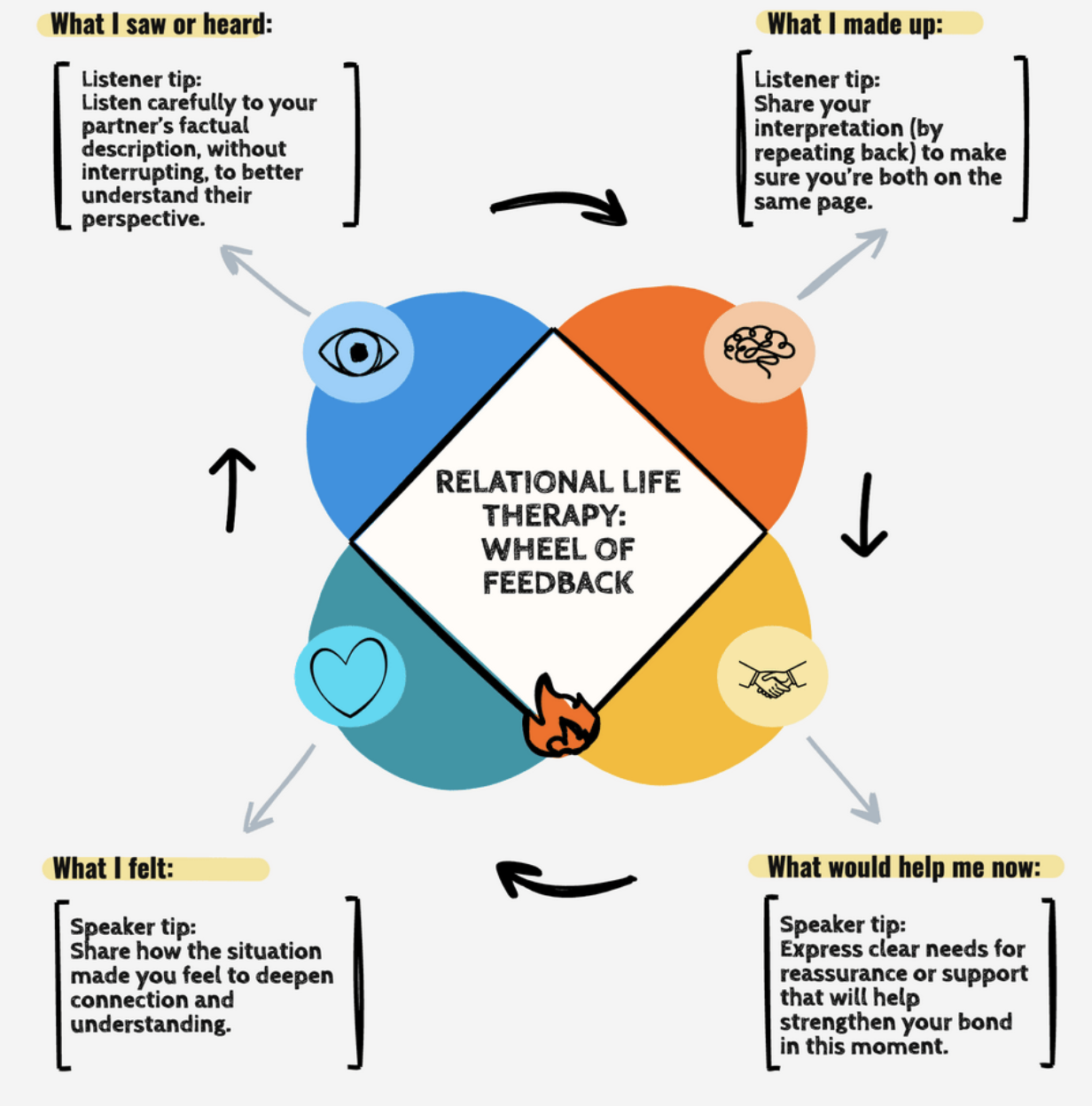
Janet Hurley’s Feedback Wheel
Many couples come to therapy feeling stuck in the same arguments or emotional distance.
RLT helps couples understand why those patterns happen and how to move toward a more honest, connected relationship.
If you’re curious whether this approach might help your relationship, we can explore that together in a consultation.
The Evidence
About 70–75% of couples who participate in couples therapy report improvement in their relationship (American Association for Marriage and Family Therapy (AAMFT)
RLT is based on over 30 years of clinical work with couples and integrates research from attachment theory, family systems, trauma psychology, and neuroscience.
Relational Life Therapy (RLT), developed by Terry Real, focuses on helping couples understand the patterns that developed from their early relational experiences and how those patterns show up in their current relationship. By addressing both emotional triggers and the deeper relational dynamics underneath them, couples can learn to communicate more honestly, repair conflict more effectively, and rebuild connection.